


Dell’s latest entry-level rack server claims to offer a good mix of features, value and performance, and in this exclusive review we see whether the PowerEdge R310 delivers on these promises. It targets small businesses and remote offices that are short of space, but also aims to offer good expansion potential.
This sector is unlikely to have a dedicated server room or even an enclosed rack cabinet, so noise levels are an important consideration. We weren’t overly impressed with Dell’s PowerEdge R210, which was big on value but even bigger on noise.
At more than 24in deep, the R310 has a much longer chassis than the R210. This gives it a far less restricted interior and helps make the R310 much quieter. There are five internal dual-rotor fans, with two looking after the power-supply bay and the rest handling the processor and memory. The resultant noise levels were much lower.

The server is built around Intel’s 3400 Xeons, which are aimed specifically at entry-level uniprocessor server platforms. The review system was supplied with a 2.66GHz X3450, which is in the middle of this family of six processors, offers a 95W TDP and supports Intel’s Turbo Boost and Hyper-Threading.
Intel offers two chipsets for this processor family: the 3400 and the 3420. Whereas the 3400 chipset has no built-in RAID functions, the R310 features the higher-end 3420, which includes Intel’s Rapid Storage Technology. This provides integrated support for mirrors, stripes and RAID5 arrays.
This choice of storage permutations means you can keep costs down by plumping for cold-swap hard disks cabled directly to the embedded SATA ports. The basic Dell PERC S100 option presents the 3420 chipset RAID functions, but if you want hot-swap capabilities you’ll need to specify either a PERC H200 or H700 add-in RAID card.
The price here includes the H200 PCI Express card, which supports hot-swap SAS and SATA drives, while the H700 card adds RAID6 to the mix.
The hot-swap carriers support either 3.5in or 2.5in drives. Our review system came with a pair of 146GB SAS SFF drives included. The R310 uses the standard PowerEdge drive carriers, but we were annoyed to find that the second drive carrier was stuck firmly in its bay and couldn’t be removed. The server’s optional LCD screen and control panel sit directly above this bay and, try as we might, we couldn’t get the drive carrier out from under it without risking damage.
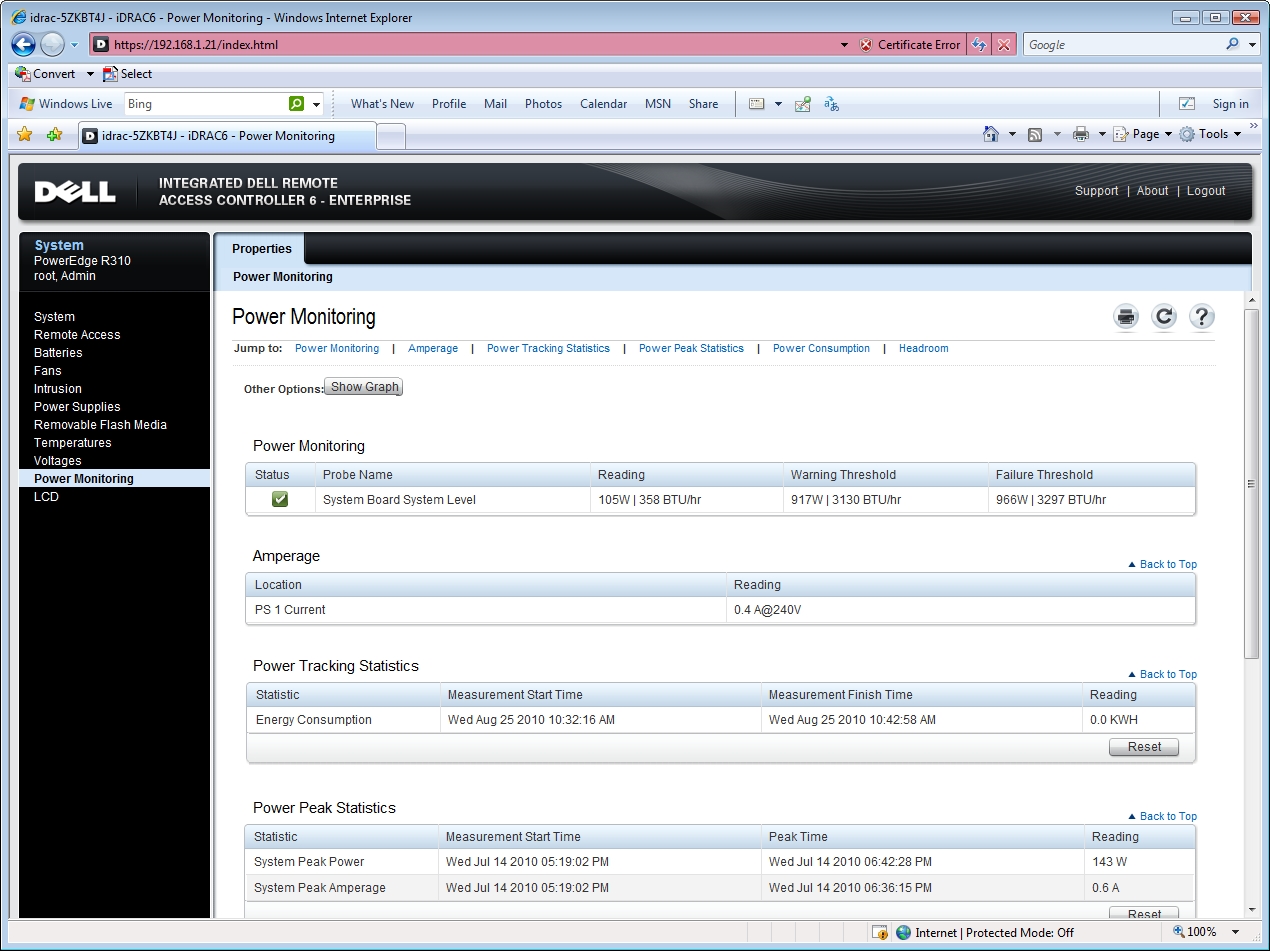
The bigger chassis brings power redundancy into play, and the review system had both 400W hot-plug supplies installed. The R310 isn’t power hungry; we measured the system drawing 78W with Server 2008 Enterprise R2 in idle and a peak of 150W using SiSoft Sandra.
The price includes 16GB of DDR3 memory, and the X3450 processor supports its maximum speed of 1,333MHz. This is as far as you can go with UDIMM memory; if you want to expand up to 32GB you’ll need RDIMM memory, which is more expensive.

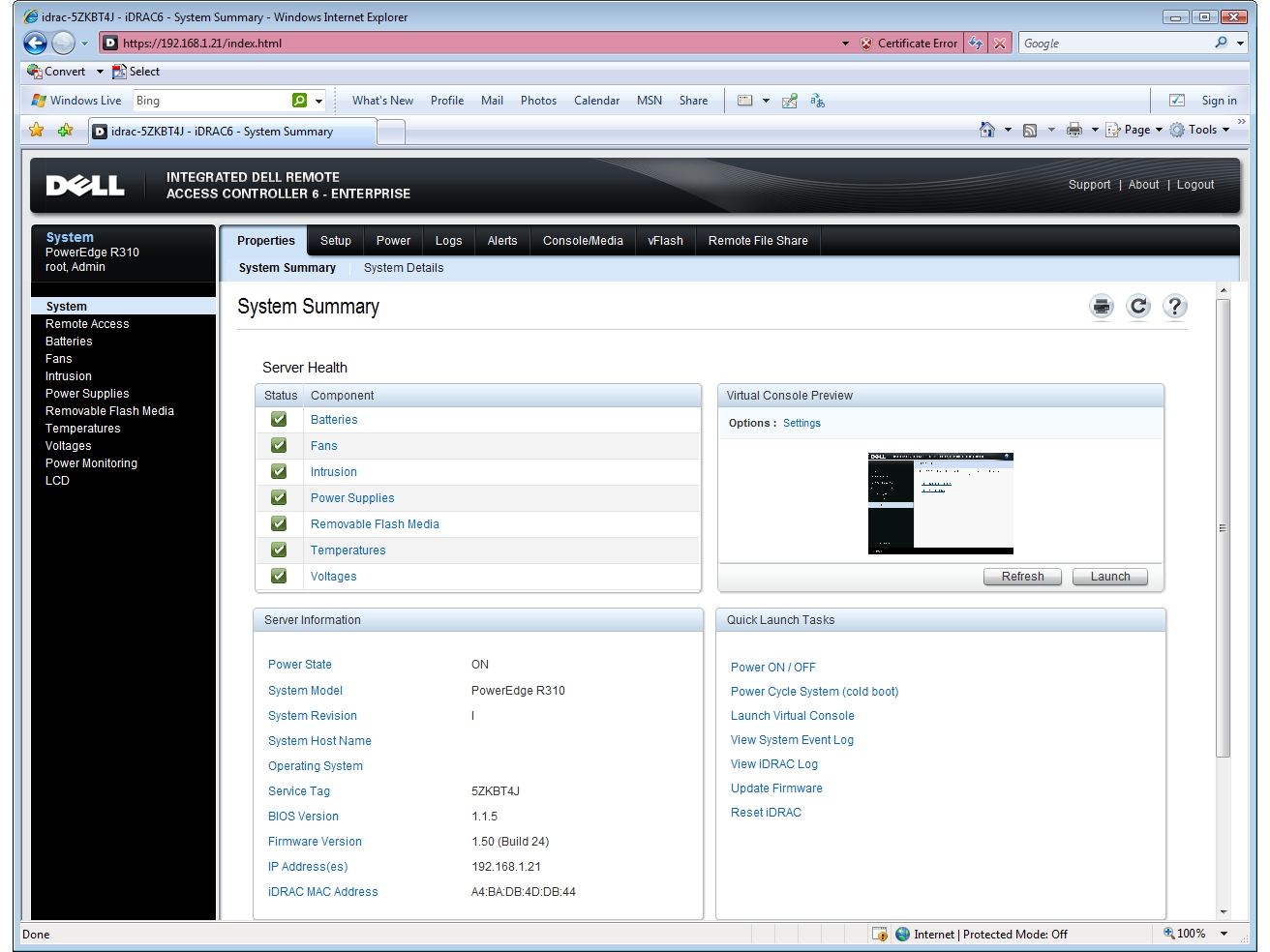
The R310 supports all of Dell’s remote management options, which start with the basic iDRAC6 embedded BMC chip. This shares management access with the first Gigabit LAN port, but you can only use the IPMISH command line utility to control server power and view error logs remotely. At the very least, we’d recommend specifying the iDRAC6 Express controller, which costs £57. This snaps into a dedicated slot on the motherboard and provides remote web access to the server for monitoring critical components, setting up alerts and controlling the power supply.
The iDRAC6 also activates Dell’s Lifecycle Controller. This 1GB chunk of NVRAM delivers Dell’s UEFI (unified extensible firmware interface) environment, which offers OS deployment wizards, a driver store, diagnostics and server update tools.
The Express option doesn’t offer KVM over IP remote control or virtual media services; if you want these, you’ll need to fit the iDRAC6 Enterprise card instead. This adds a dedicated management network port and can be upgraded further with Dell’s V-Flash media card, which is presented as persistent storage and can appear as a boot option.
The R310 also comes with Dell’s latest Management Console software, but for single-server deployments in small businesses this product is overkill since it requires a lot of resources.
The Dell PowerEdge R310 is a good candidate for an entry-level rack server. The sticking drive carriers are a cause for concern, but it’s a powerful hardware package at a good price and with plenty of room to expand.
Warranty | |
|---|---|
| Warranty | 3yr on-site next business day |
Ratings | |
Physical | |
| Server format | Rack |
| Server configuration | 1U |
Processor | |
| CPU family | Intel Xeon |
| CPU nominal frequency | 2.66GHz |
| Processors supplied | 1 |
| CPU socket count | 1 |
Memory | |
| Memory type | DDR3 |
Storage | |
| Hard disk configuration | 2 x 146GB Dell 10k SAS SFF hard disks in hot-swap carriers |
| Total hard disk capacity | 292 |
| RAID module | Dell PERC H200 PCI-E SAS 6Gbits/sec RAID card |
| RAID levels supported | 0, 1, 10, 5 |
Networking | |
| Gigabit LAN ports | 2 |
Power supply | |
| Power supply rating | 400W |
Noise and power | |
| Idle power consumption | 78W |
| Peak power consumption | 150W |

Disclaimer: Some pages on this site may include an affiliate link. This does not effect our editorial in any way.