
The latest ProLiant MicroServer shows HP is now taking a lot more interest in small businesses of up to ten users that have traditionally avoided the cost and complexity of an office server for functions such as file sharing.
HP is offering the MicroServer at a very low price. Only one model is available and its starting price of £219 will have a more than a few small businesses taking notice.
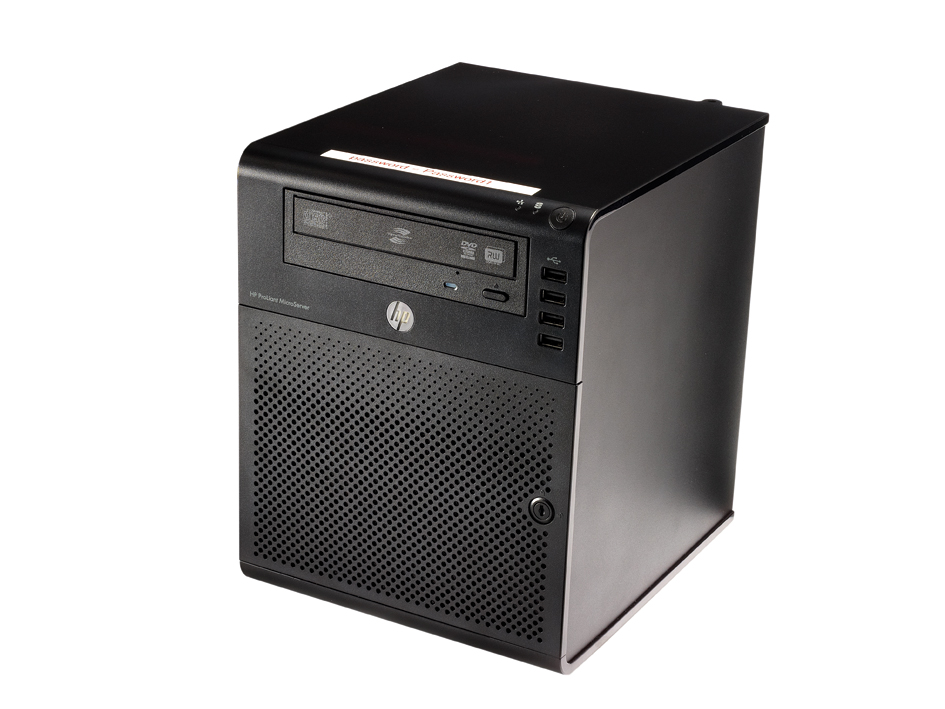
For this, you get a chunky little desktop cube equipped with a dual-core 1.3GHz AMD Athlon II Neo N36L processor and 1GB of DDR3 memory. The price includes a single 250GB SATA hard disk with room for three more inside, but the cheap plastic removable drive carriers arenÕt very sturdy.
No OS is included, but HP offers a choice of Red Hat Enterprise Linux or Windows Server R2 Standard and Foundation. We can’t see small businesses with limited IT skills wanting to mess with Linux, so Server 2008 R2 Foundation would be the best bet, which HP will preinstall for £169 exc VAT.
There are a number of restrictions with Foundation. It can handle up to 30 simultaneous inbound connections and supports a maximum of 15 Windows user accounts. It’s 64-bit only, supports multiple cores but a single processor socket and won’t let you upgrade beyond 8GB of memory.
The MicroServer is well built, with a lockable metal door protecting the hard disk carriers. Up above is a single 5.25in bay, which is empty on base systems. We had the optional DVD-RW drive supplied in the review system, which costs an extra £35 exc VAT.
To fit an optical drive, you unlock the front door and release the top panel, which slips off easily enough. Don’t try fitting your own drive as the HP model is only 17cm deep and has two special screws on each side, which mate with slide rails inside the chassis.
The small power button on the top is a little too exposed, but fortunately wonÕt shut down the OS down if pressed accidentally. Below this are four USB 2 ports with another inside, plus two more round the back along with an eSATA port.
There may be four drive bays, but hardware RAID options are very limited. The motherboard uses an AMD RAID controller, which only supports JBODs, stripes and mirrors, so RAID5 or 6 arrays are off the menu.
The controller doesn’t support hot-swapping, so if a drive fails the server must be powered down to replace it. It can handle 2TB SATA drives, though, so future storage expansion looks good.
As you’d expect, it’s cramped inside. The only way to access the pair of PCI-E slots and memory sockets is to release the motherboard in the base and slowly slide it forward, unplugging the various interface and power cables as they become exposed. It takes time, but your patience will be rewarded.
The embedded AMD processor may not be overly powerful, but its TDP of 12W keeps consumption right down. We measured the review system drawing a mere 22W with Foundation in idle, which rose to only 31W with SiSoft Sandra pushing the processor to the max.
The MicroServer is also very quiet. A single 12cm diameter fan looks after chassis and hard disk cooling, and this could only be heard by getting close to the back of the server.

Another feature that sets the MicroServer apart from a standard desktop is HP’s optional Remote Access Card (RAC). Costing £55 exc VAT, it slots into the x1 PCI-E slot and provides a dedicated network port for remotely managing and monitoring the server.
Once it’s installed, a new IPMI option appears in the BIOS menu, where you can assign a fixed IP address to the card or leave DHCP to hand one out to it. In terms of features, we put the RAC in between HPÕs entry-level Lights Out 100i and its top-end iLO3.
The web interface provides details on fan speeds and temperatures, plus the ability to power the server on and off or reset it remotely. Platform event filters can be used to assign actions to specific events, so if the fans fail or temperatures rise the server can be automatically powered down, reset or rebooted.
Two features that make the RAC great value are KVM-over-IP remote control and virtual media services. The former provides full remote access to the BIOS menu and OS, while the latter allows you to present devices such as optical drives over the network for the server to use.
The MicroServer is definitely worth considering as a first server since it’s good value, small, quiet, has decent storage potential and can be remotely managed. It’s short on performance and upgrades will be time-consuming, so if you want more processing power and easier internal access then consider Dell’s PowerEdge T110, although this costs at least twice as much.
Ratings | |
|---|---|
Physical | |
| Server format | Desktop |
| Server configuration | Desktop chassis |
Processor | |
| CPU family | AMD Athlon |
| CPU nominal frequency | 1.30GHz |
| Processors supplied | 1 |
| CPU socket count | 1 |
Memory | |
| RAM capacity | 8GB |
| Memory type | DDR3 |
Storage | |
| Hard disk configuration | 250GB Seagate Barracuda SATA hard disk in cold-swap carrier |
| Total hard disk capacity | 250GB |
| RAID module | embedded AMD SATA RAID controller |
| RAID levels supported | 0, 1, JBOD |
Networking | |
| Gigabit LAN ports | 1 |
Noise and power | |
| Idle power consumption | 22W |
| Peak power consumption | 31W |

Disclaimer: Some pages on this site may include an affiliate link. This does not effect our editorial in any way.