Everyone seems to be in search of a good Text to Speech (TTS) tool that does it all: natural-sounding dialogue that understands context, and can turn massive chunks of scripting into engaging audio. Today we’re looking at Microsoft VibeVoice TTS, an open-source offering that, if not meeting those criteria, then certainly is an amazing leap towards it.
Join us for our VibeVoice AI review.
Good Vibrations – Our VibeVoice AI Review
We’ve broken our review down into sections for easy reference and to cover different aspects of the tool.
What Is VibeVoice AI?
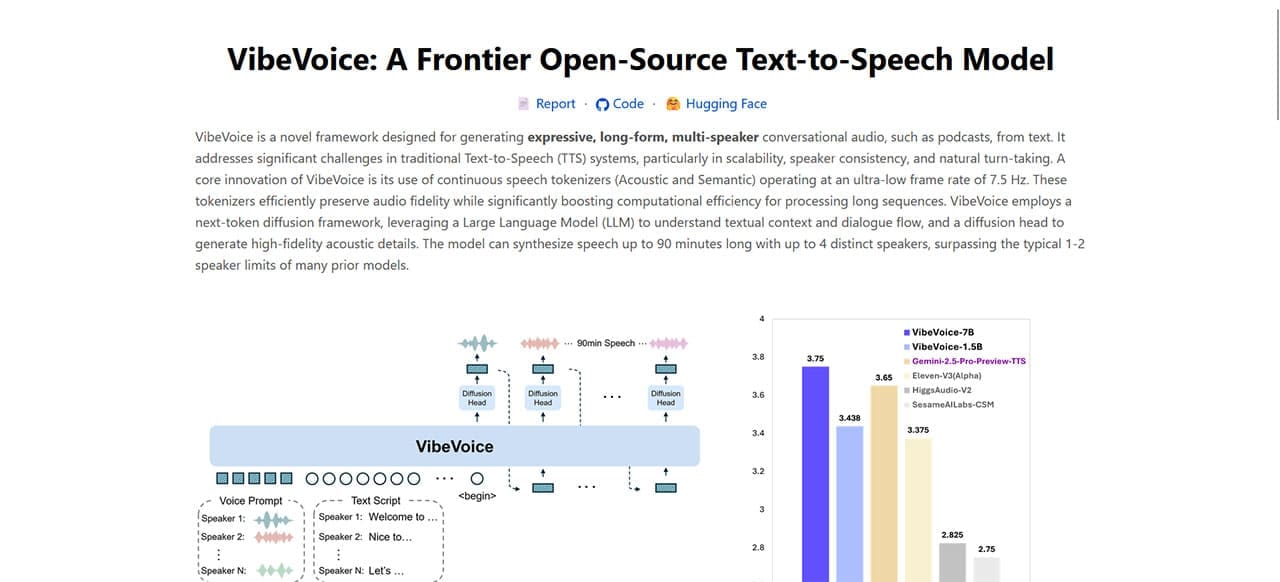
Unlike so many other AI tools and products that we review on this site, VibeVoice is not any one site or platform, but rather the power behind them. It’s a TTS developed by Microsoft with the stated goal of furthering TTS development for all, distributed on GitHub.
As of September 2025, Microsoft restricted public access to the downloadable TTS model because of responsible AI concerns, although the project documentation and model cards remain available.
Under the Hood
What is the tech that drives VibeVoice? The engine behind VibeVoice is a large generative text-to-speech model. Any PC running its 1.5B parameters is going to need no small amount of VRAM to get the job done, which is definitely restrictive to smaller organizations and individual users.
The biggest features of VibeVoice that set it at the forefront of its field are:
- Voice Cloning and Language Support – VibeVoice natively supports both English and Chinese. Other languages will require voice input to clone, but can competently do so quickly, and only with a few snatches of audio. The voices themselves are remarkably natural and offer great possibilities for use (and unfortunately misuse).
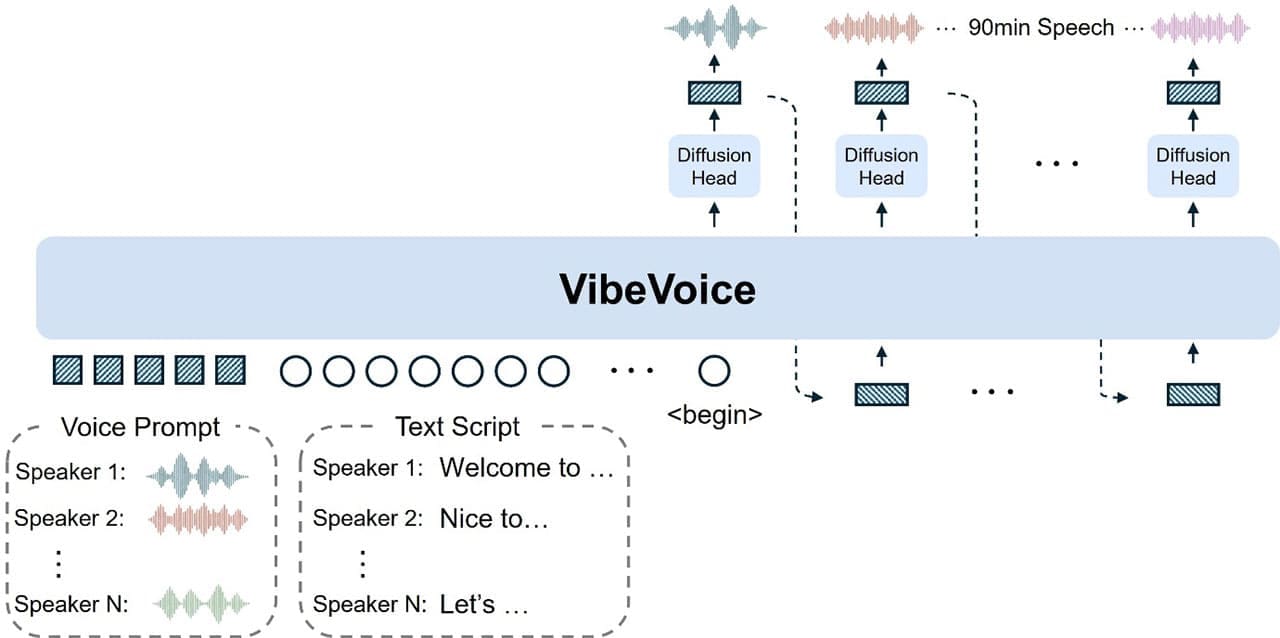
- Multiple voices – Unlike other TTS tools, VibeVoice allows for up to four voices in a script, speaking in turns. Although this excludes overlaps and flubs that would make a clip truly lifelike, this is nevertheless very impressive.
- Context awareness – Some tools require scripts to provide voice direction to better emulate emotions, while VibeVoice instead applies emotion and pacing through context awareness and cues within the actual script.
- Length and speed – Perhaps the standout feature of VibeVoice is the up to 90 minutes of audio it can generate at a time. Thanks to its efficient acoustic token representation and model architecture, VibeVoice can generate TTS in hours what has previously taken much longer. What’s more, it maintains a consistent context awareness and quality in audio generation (with some pacing issues), which is truly impressive.
Who Is It For?
Because of its high demand in terms of computing power and resources required, it’s clear that not everyone will be able to have VibeVoice TTS installed on their home machines. The stated goal of the AI by Microsoft is more for R&D use rather than commercial, being MIT-licensed.
That said, there are no hard and fast rules for use, and a quick search online will reveal just how many commercial companies are using VibeVoice on a paid (credit-based) basis. Sites like AuraVoice and VibeVoices will use the tool’s name either as part of their own or in their hyperlink to draw in subscribers.
The underlying research project is freely available, while many third-party services charge for convenient hosted access.
Related Posts
 What to Do When ChatGPT Is Stuck Generating Images
 How to Generate Text From Speech With AI
 Can ElevenLabs AI Bring Your Text to Life?
 Four AI Tools to Transcribe WhatsApp Audio to Text
 How to Spot AI-Generated Text
 Best AI Tools for Novel Writing and Creative Writing
 How to Use Cursor AI Code Editor
 Is The Librarian the Best WhatsApp AI Assistant?

Disclaimer: Some pages on this site may include an affiliate link. This does not effect our editorial in any way.