PC manufacturers seem to be getting more ambitious by the month when it comes to overclocking Intel’s current roster of processors. As if to demonstrate that fact, Gladiator’s latest machine, the Trident SLI Black Pearl, arrived in the PC Pro Labs with its Core i7-930 chip boosted from 2.8GHz to 4GHz.
That isn’t the i7-930’s only impressive statistic. As befits a part that sits snuggly in the upper echelons of Intel’s range, it’s kitted out with the full range of mod-cons, from Turbo Boost and Hyper-Threading across its four cores, to a combined 10MB of L2 and L3 cache.
The combination of potent specification and dramatic overclock reaped rewards in our application benchmarks. An overall score of 2.8 is the third-fastest in PC Pro history, and only 0.03 behind the current record-holder, the CyberPower Liquid i7 Kraken. In short, it’s far more power than most will ever need to fully harness.
Sitting below the processor is a pair of Nvidia GeForce GTX 460 graphics cards. We were impressed with it when it was released in July, and this is the first time we’ve seen two running in SLI. It’s also the first time we’ve seen these cards overclocked, with Aria boosting the 675MHz core to a nippier 800MHz.
Our tests revealed that lashing two GTX 460s together is a good idea. The Gladiator’s score of 57fps in our Very High quality Crysis benchmark is one frame faster than the Mesh 7’s, which was kitted out with an ATI Radeon HD 5970, and a playable 35fps in the same benchmark at a higher resolution of 2,560 x 1,440 is even more impressive.
The rest of the specification is just as accomplished. Six gigabytes of RAM is more than we see in most systems. Windows 7 Home Premium 64-bit is installed on a 64GB Crucial RealSSD solid-state drive to speed up boot times and system. Traditional storage takes the form of a 1TB Samsung SpinPoint F3 hard disk, and there’s a DVD writer too. The only disappointment is the absence of a Blu-ray drive.
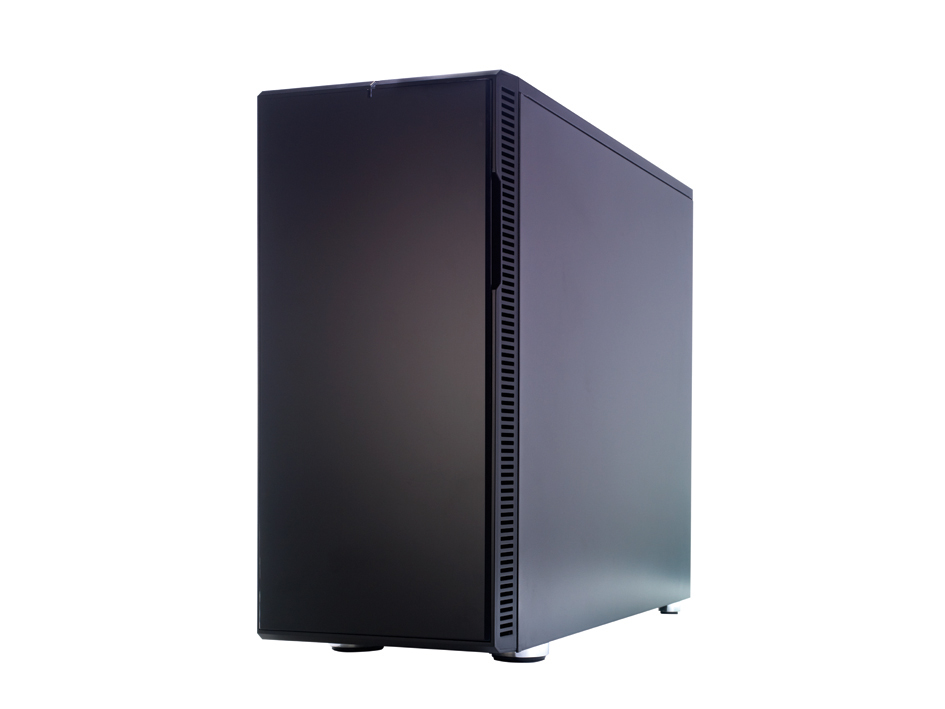
The chassis looks good, and although we haven’t seen the Fractal Design Desire R2 before, its clean, minimalist lines and glossy black finish make a positive first impression. Build quality is excellent, and there are plenty of ports and sockets, with a pair of USB 2 and eSATA connectors on the front, plus USB 3, FireWire, PS/2 and more on the rear.
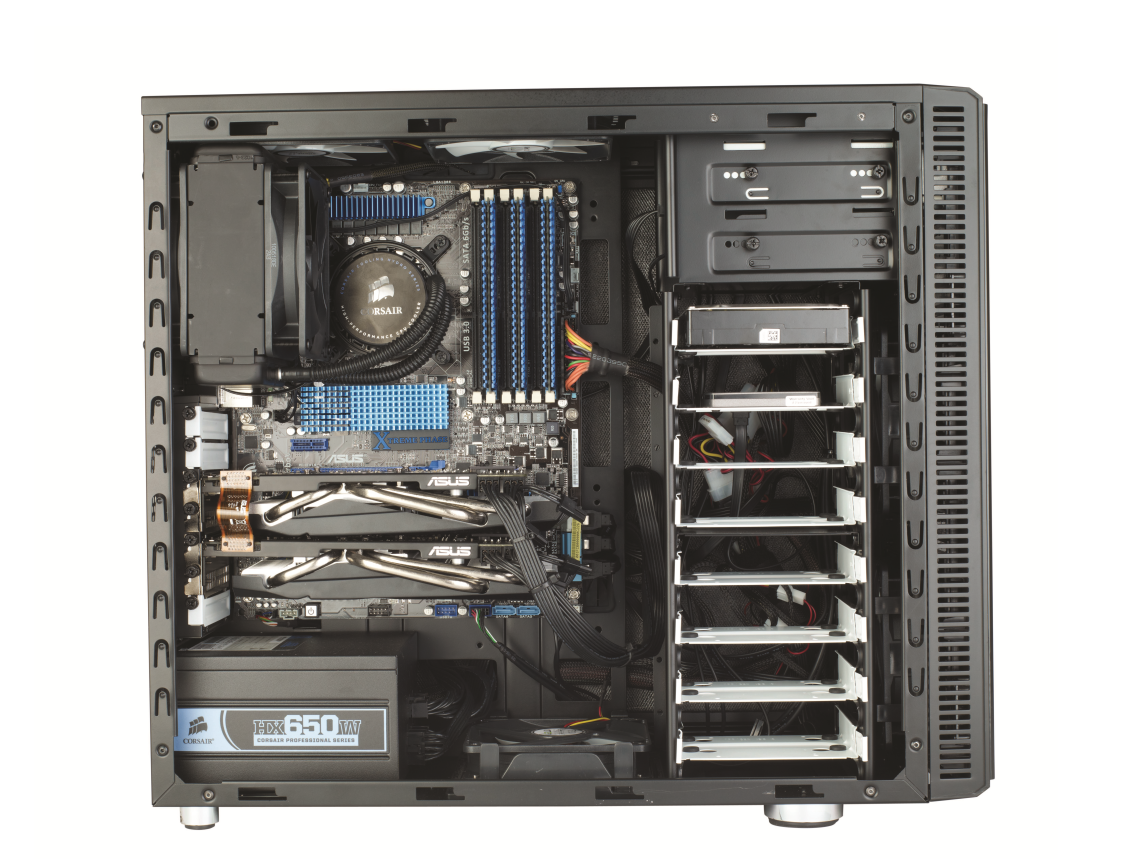
Inside, both side panels are coated in noise-absorbing bitumen, and the inside of the sleek door is layered with foam – all nice touches aimed at keeping intrusive fan whirr and vibrations to a minimum. The power supply sits on rubber feet, and the hard disk cages – oddly painted white – are finished with small rubber pads.
Keeping things tidy is important in a PC that’s inevitably going to be upgraded at some point in the future, and it’s good to see plenty of attention to detail here. The motherboard tray is littered with rubber-edged cable routing holes which, when coupled with the modular PSU, results in very neat interior.
It isn’t the biggest case, but there’s a reasonable amount of upgrade room. Six of those bright hard disk cages lie empty, there are three unimpeded DIMM sockets free that can handle up to 24GB of DDR3 RAM, and a single PCI Express x16 slot is free, although note the inclusion of two graphics cards restricts it to just x1 speed. A single SATA/600 socket lies vacant too, as does one 5.25in drive bay.
This competent case has been ruined, however, by Gladiator’s additions. The CPU, for instance, is kept cool by Corsair’s H70 water-cooling kit. This self-contained system consists of a 120mm reservoir sandwiched between a pair of fans. Despite the sound-dampening measures, those two fans proved noisy, churning out a low rumble as soon as we booted the system.
The pair of graphics cards was even louder, with each emitting a high-pitched whining noise while gaming. This increased as we put them under load. It can’t help that cards are so close together – there’s only a 3mm gap between the two.
The cooling setup isn’t even particularly efficient. We stress-tested the processor and found it hit a peak of 89 degrees – disappointing for a water-cooled chip, even with its overclocking taken into account – and, while the lower graphics card peaked at a reasonable 64 degrees, the higher card struggled for air, reaching 91 degrees Celsius during our stress test. That’s too high for our liking.
And then there’s the price. At £1,190 exc VAT, the Gladiator sits beside systems such as the Chillblast Fusion Photo OC III and, while the Black Pearl is faster, the Chillblast is both cooler and quieter. That money would also buy you the Wired2Fire Hellspawn XFire, which offers similar levels of performance and a full set of peripherals.
It’s worth mentioning that Gladiator has gone to great lengths to ensure quality components are used throughout, from the X58 motherboard and Patriot Viper performance memory to the Crucial SSD and Fractal Design chassis, but it’s clear that your money could go further elsewhere.
It’s one thing to put together the fastest system we’ve ever seen, but quite another to make that same machine easy to live with. Gladiator has aimed high with the Black Pearl, but its lightning-fast components are just too much for the compact chassis to cope with, and the resulting noise and heat levels mean we just can’t recommend it.

Disclaimer: Some pages on this site may include an affiliate link. This does not effect our editorial in any way.