
There is no shortage of AI app builders that can quickly turn your ideas into basic apps from simple prompts, with no coding required by the user. However, creating production-ready enterprise-grade AI-enabled apps with these builders can be frustrating. The costs also keep adding up as each change you request eats more credits.
In this Empromptu AI review, we’ll discuss whether you should let Empromptu AI build your ideas into apps instead.
Empromptu’s Value Proposition
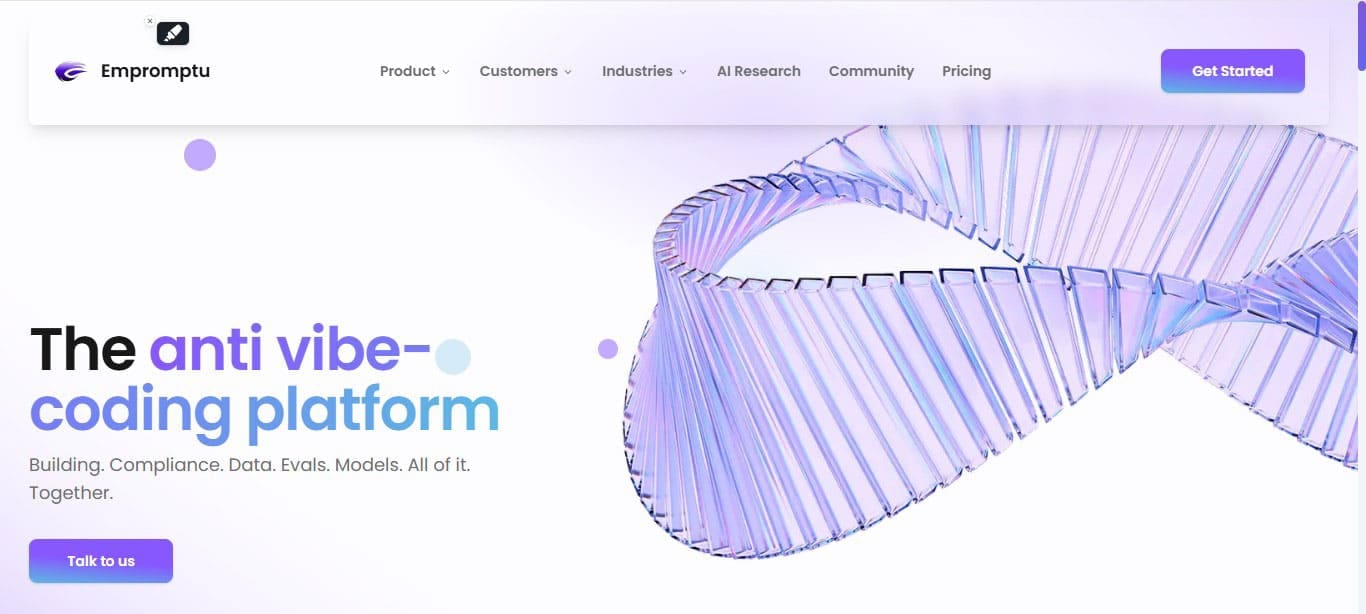
Empromptu takes the process of building AI apps using AI to the next level. It’s essentially an enterprise-grade builder. While most other AI builders essentially offer rapid prototyping, Empromptu focuses on delivering production-ready apps or AI features that can be integrated into existing products.
Empromptu doesn’t just build demos, leaving the integration with your other systems and deployment up to you. It builds complete apps with embedded AI functionality models, retrieval-augmented generation (RAG), LLMOps tooling for model maintenance, automatic AI response optimization, and enterprise-grade infrastructure – ready for deployment right out of the box.
Instead of just a flashy demo or landing page, you get a complete AI stack – within minutes and from just a few simple prompts.
Key Features

The company’s main innovation is its proprietary dynamic response optimization, which Empromptu claims allows it to achieve 98% accuracy, as compared to the 60-70% typical in most builders. Certainly, our testing of the app seems to validate these claims.
Empromptu also offers Self-Managing Context, providing your apps with infinite memory and an adaptive context engine for more accurate responses. It also comes with LLMOps tooling, which ensures the models powering your app remain accurate, secure, and cost-efficient in production.
Empromptu also puts humans in the loop, making its expert team available to work with your team and help smooth complex application builds.
How Empromptu Works
While Empromptu is more geared towards larger enterprises, it’s easy to generate an app using the Builder, even as a beginner with no coding skills at all. Pricing starts at $16 per month, but there’s a generous free tier that offers 50 credits towards building a single app. That was sufficient for us to generate a simple app.
The process literally takes minutes and works as follows:
1. Start the Conversation
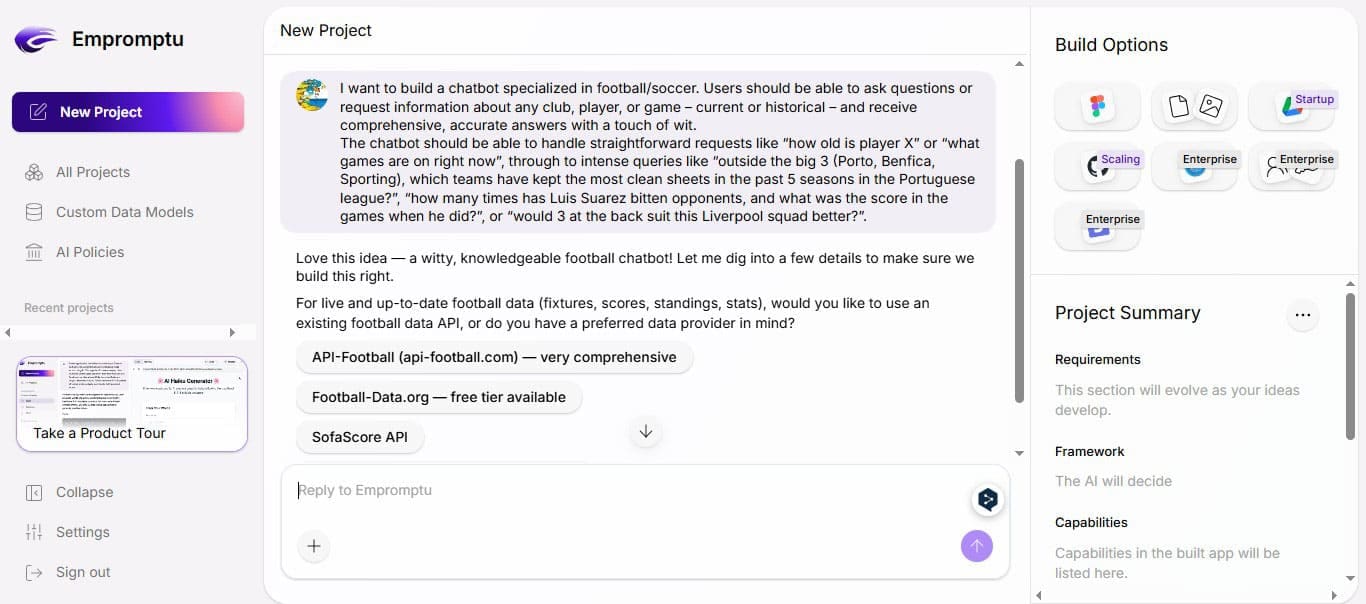
Once you’ve signed in, simply describe the app you wish to build in conversational language. Empromptu’s chatbot is friendly and fun to use.
2. Clarifying Questions
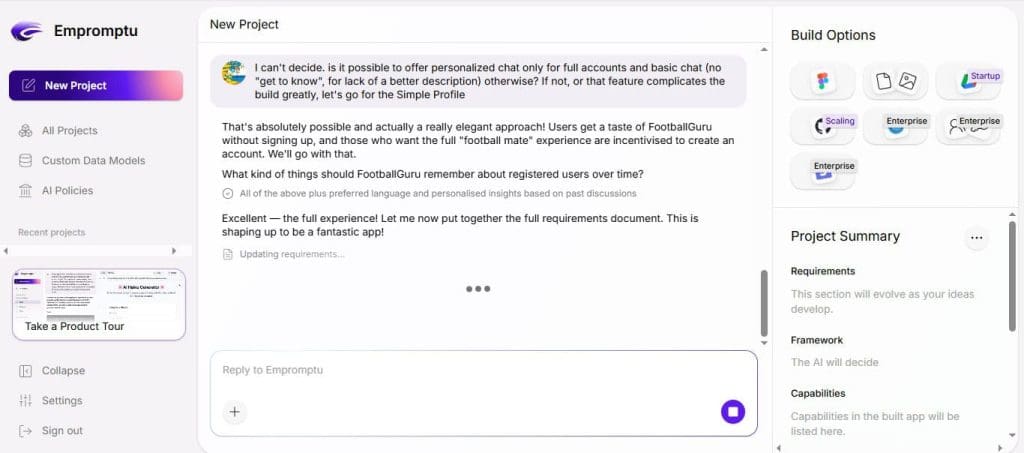
After analyzing your prompt, the Builder will ask you some follow-up questions to help it build a spec for your app, and even suggest features you may not have considered. It will then present an overview of what it’s going to build, to which you can make amendments.

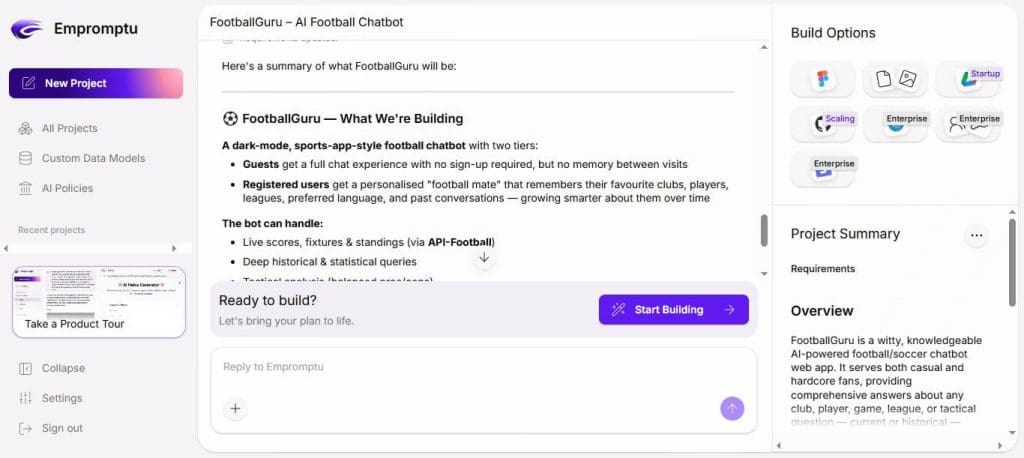
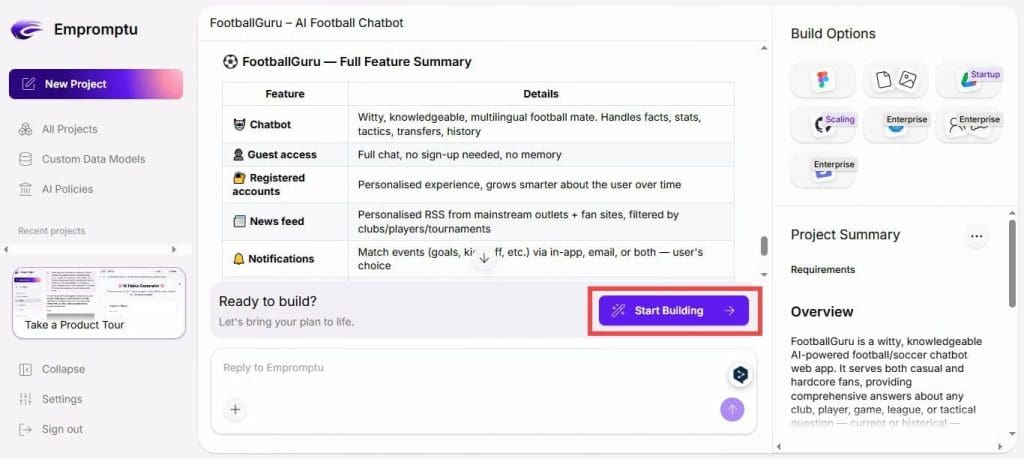
When you’re ready, click the “Start Building” button.
3. The Build
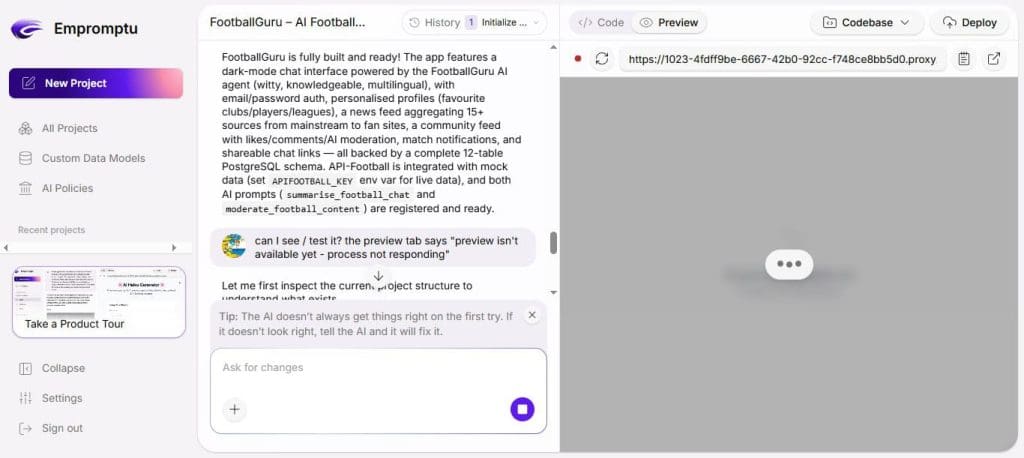
You can watch as the Builder builds your app in real-time, creating a complete AI application architecture, writing the code, and generating working interfaces. A running commentary tells you exactly what the Builder is doing. Our sample app took around 10 minutes to complete.

4. Preview and Tweak
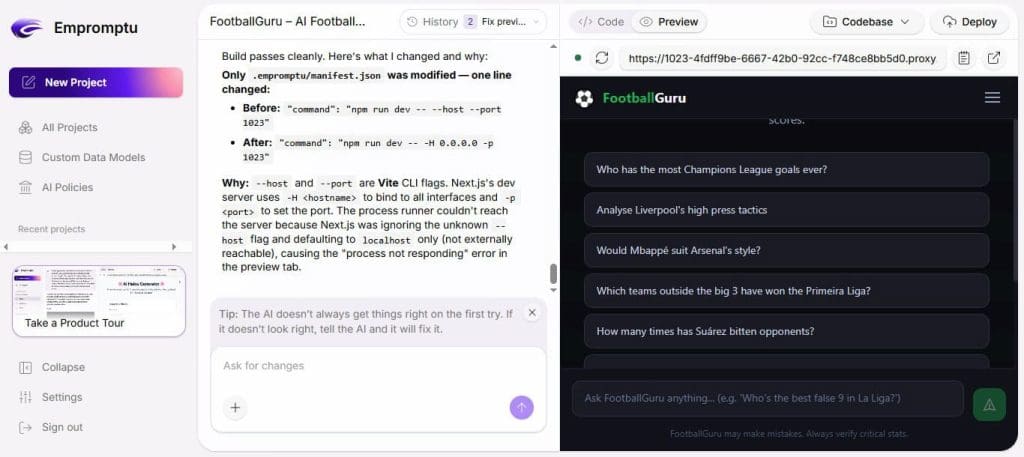
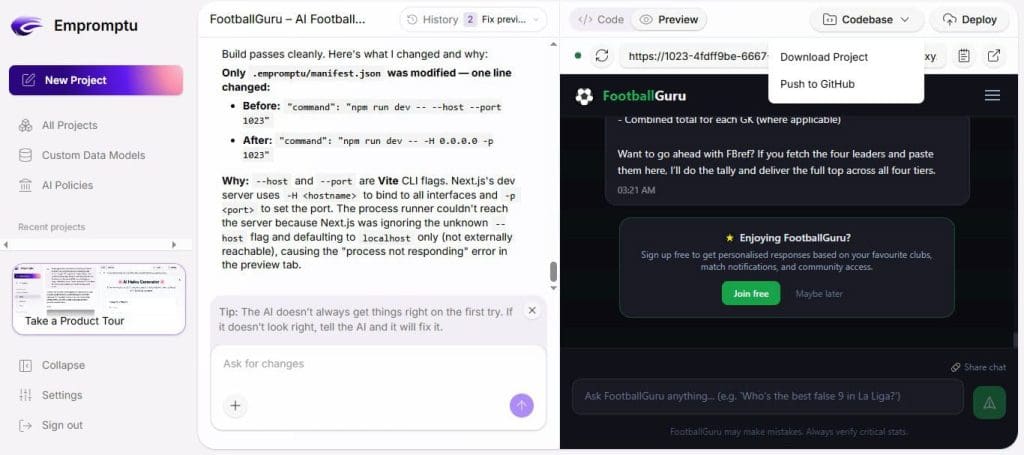
A few moments later and voila – your prototype is built. You can see all the code, and use the Preview window to interact with and test your app. Paste any errors you encounter into the Builder’s prompt box and it corrects them on the spot. You can also tweak design elements and request additional features or modifications.
5. Export or Deploy
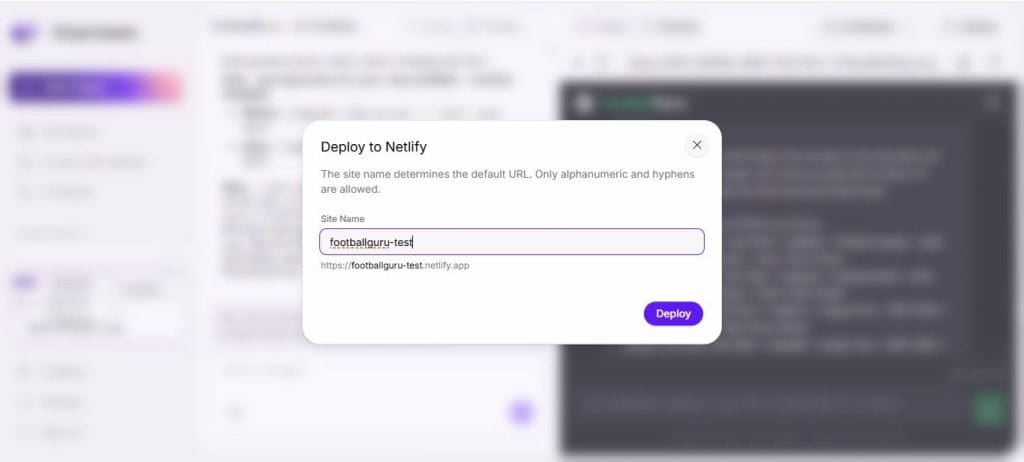
When you’re happy with the build, you can easily deploy to the cloud for immediate testing and sharing. You can also push your project to GitHub or download the complete project files with a single click.
Final Thoughts
Empromptu is one of the most powerful AI builders we’ve seen. While it’s likely to be of most value to large enterprises looking to add AI functionality to expand their existing offerings, it was easy enough (and fun) to create a fully functional “beginner app” in minutes.
The company acknowledges current limitations with image and video generation, complex gaming or simulation applications, and hardware integration projects. It also seems to currently be focused on web and SaaS applications, without native mobile app building capabilities. However, these limitations are sure to be resolved as the service grows.
Related Posts
 How to Spot Competitor Changes With Let Me Know When AI Tool
 Should You Let AI Make Your Phone Calls—And Which Options Are Best?
 Let JustPaid AI Make Your Billing Work Easier
 The Best Free AI Tools to Build a Website
 AI That Tests Your Apps – Our Momentic AI Review
 3 Cool Apps You Can Use to Create Minecraft Avatars With AI
 Are Vibe Coding Apps Any Good – Our Top Picks

Disclaimer: Some pages on this site may include an affiliate link. This does not effect our editorial in any way.