
Considering how prominent AI content generation is, Google and other search engines place increasing importance on the quality, originality, and usefulness of articles. That means that any SEO tools are much more useful when they can accurately dig through unused keywords and content gaps rather than creating full articles.
But can you actually leave every part of content generation to an AI in 2026? It’s the question the SEO Agent hopes to answer. Read our The SEO Agent AI review to find out how this platform tackles the task.
What Is The SEO Agent AI and Getting Started
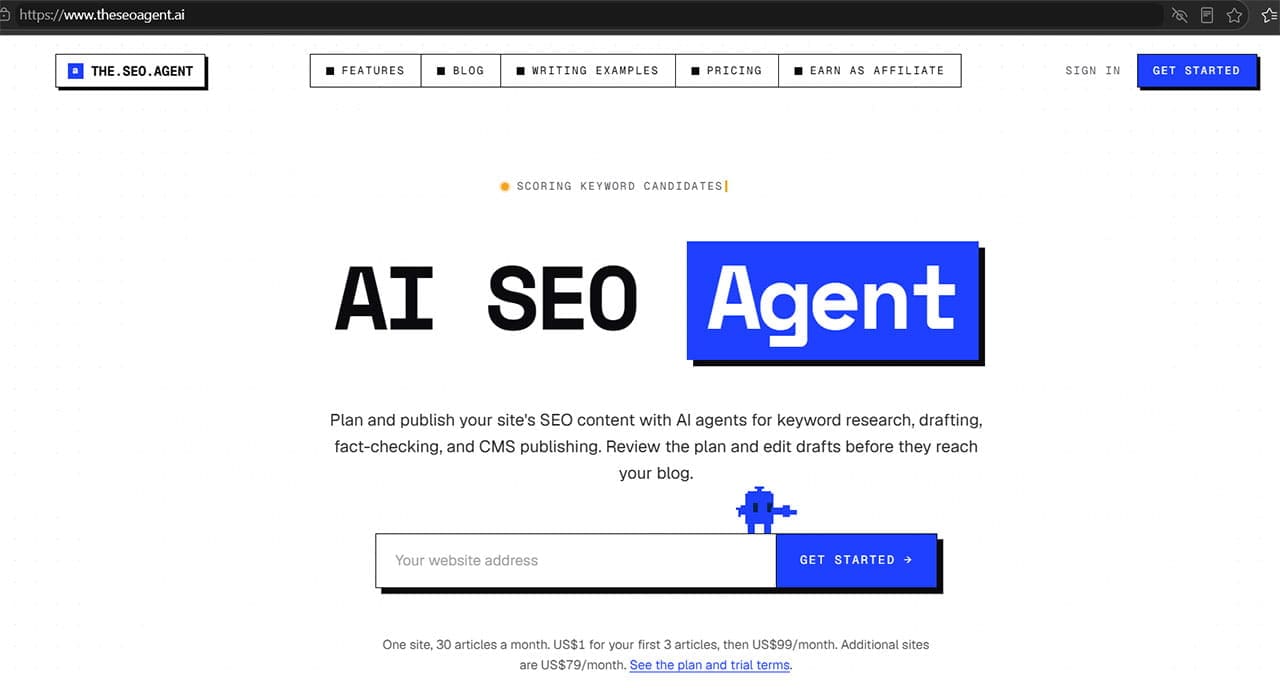
The SEO Agent is a relatively new AI-based SEO platform that crawls through a website, checks its metadata, and finds similar competitors to propose, draft, and even publish content on your behalf.
The core of the tool is handling all parts of content generation by going through the website’s sitemap and finding pages that competitors have recently covered, then filling that gap with similar articles.
The platform creates exactly one new article a day and comes with a single subscription model that allows you to link your publishing platform, like WordPress, for automatic posting.
Before you can get started with the tool, it provides a straightforward review and suggestions on what it thinks your website needs.
The SEO Agent AI Review: Main Feature
When you’re getting started, the tool will list your site’s main issues and provide the initial three-day content plan.
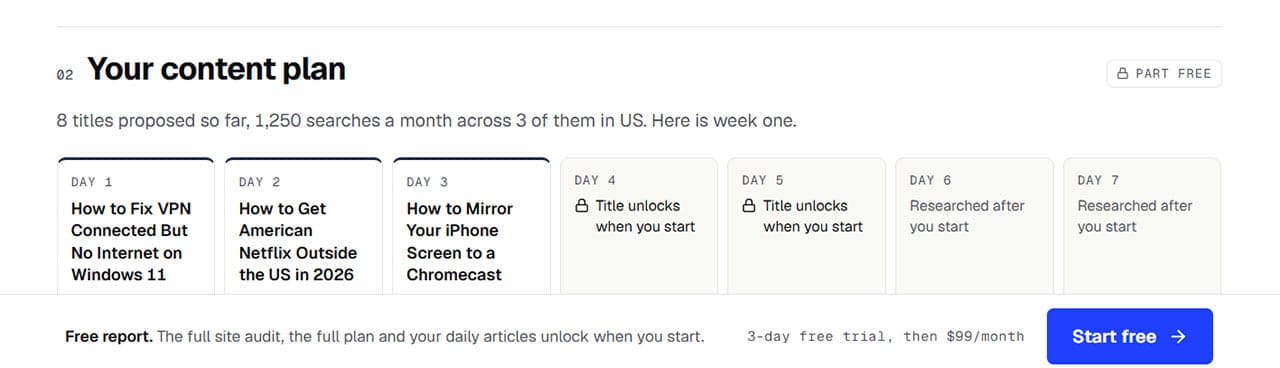
Notably, during the initial setup, the tool asks you to define your target audience and list your main competitors. This can be both good and bad, since past content may still influence a website that has recently shifted its focus.
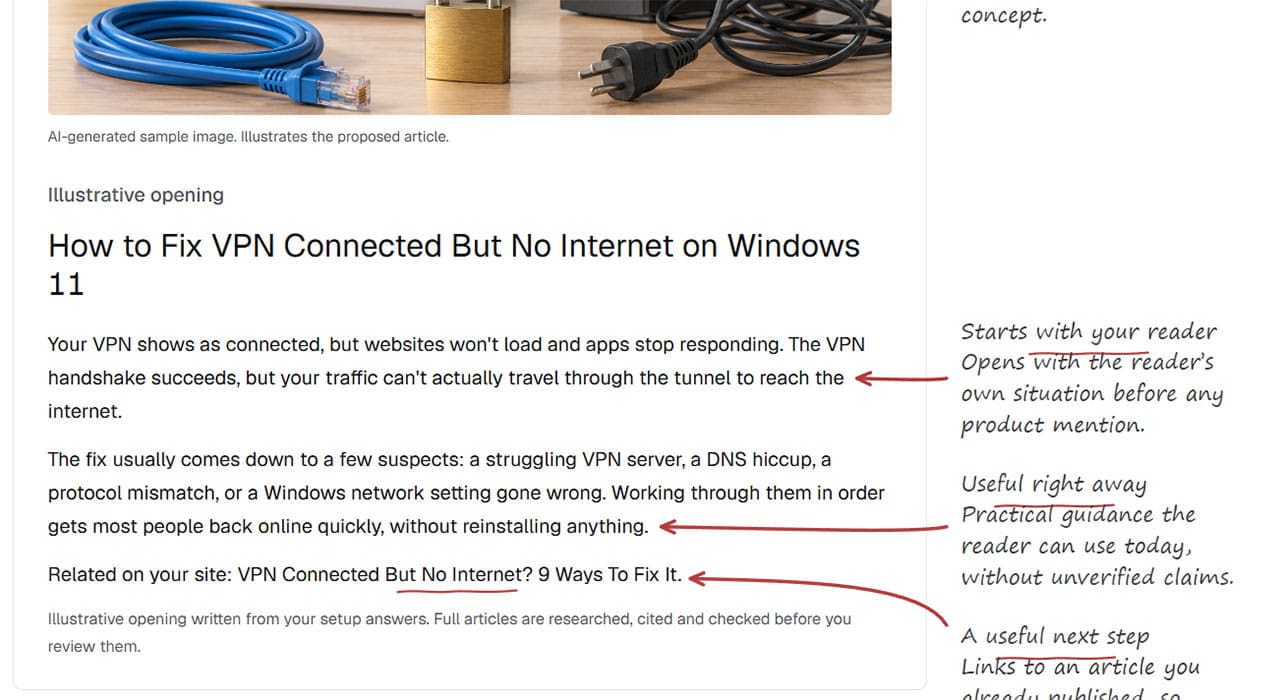
The biggest issue here is that the tool requires a properly set-up website with a healthy sitemap. If it can’t read recent pages (which the AI tool doesn’t seem to be able to for some reason), it can recommend the same article you already have. For example, the SEO Agent provided a report just a few days after the team covered the “How to Fix VPN Connected But No Internet” topic.
More bafflingly, the tool’s first instinct was to provide its first article with a hyperlink to an article that covers the same topic. This could create keyword cannibalization, with the two pages competing for the same search traffic.
If you do decide to pay for the three-day trial, the dashboard and initial results are a bit more promising.
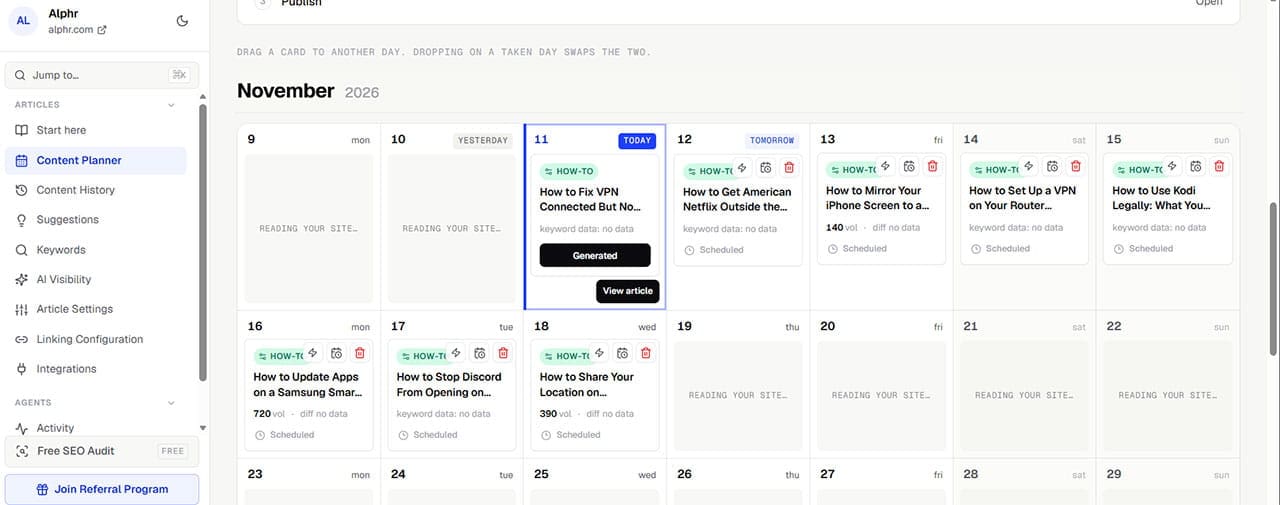
The tool takes about three minutes to generate an article, but that background activity (and any other work by the AI agent) usually freezes the entire dashboard, so it’s worth waiting it out.
You can manually view and edit the generated article, or ask the AI to streamline it or add or remove sections. However, the AI won’t be able to change the structure, keywords, or the topic meaningfully.
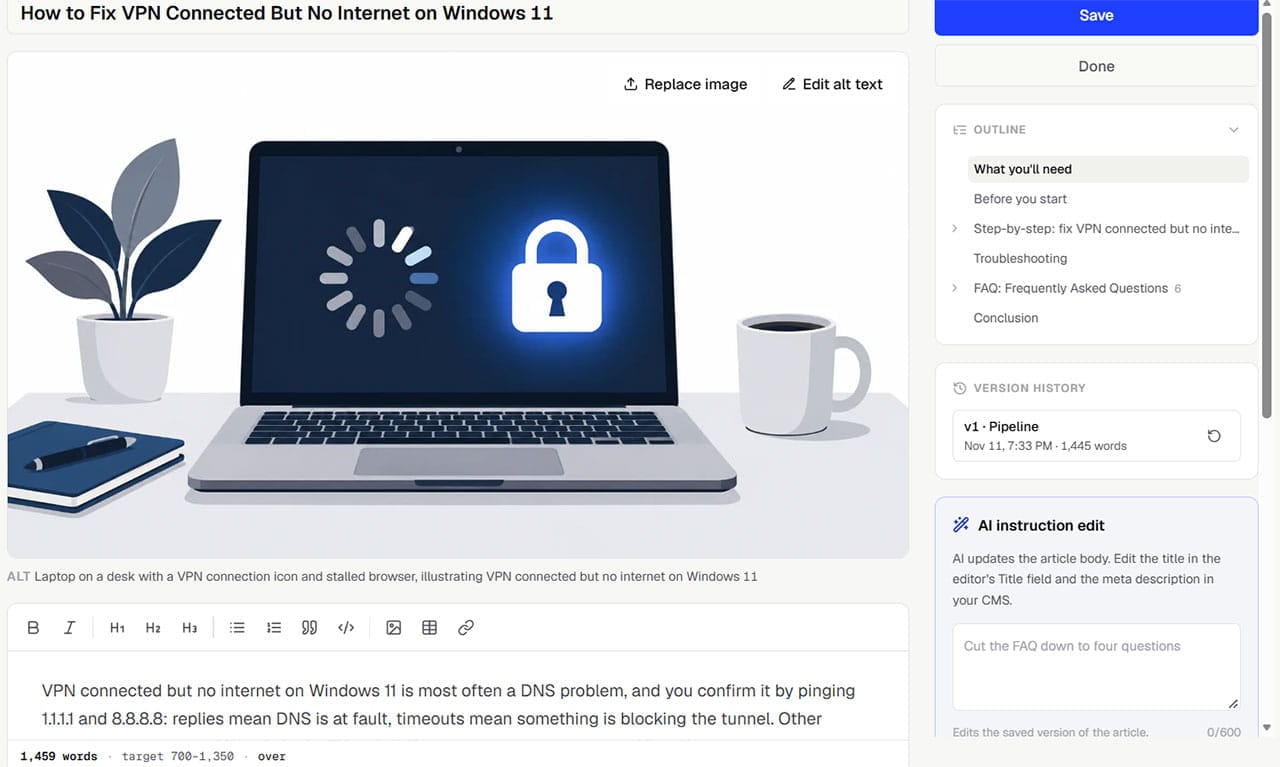
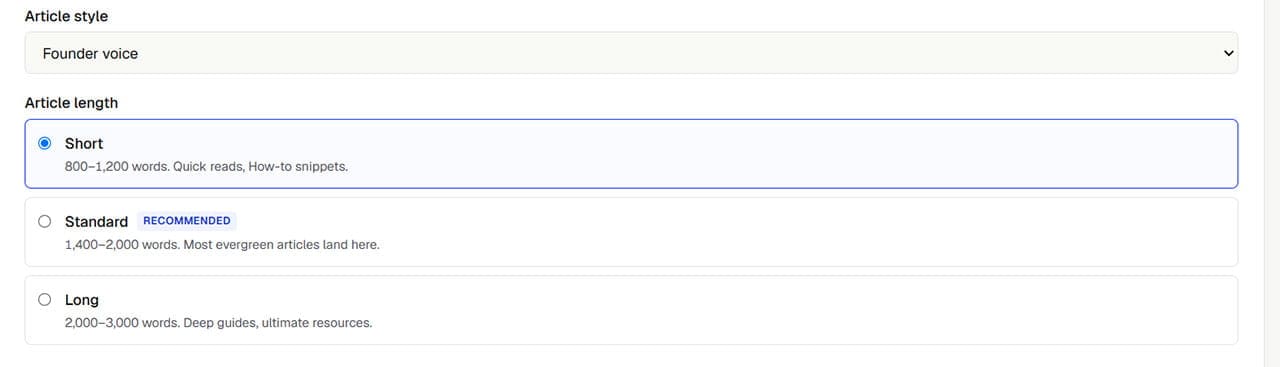
The actual quality of the writing is a bit debatable. When prompted to create a short article (800 to 1,200 words), the AI builds it with a generic intro-main-outro formula that overwrites simple steps and bumps up the word count to 1,500. More curiously, the same 800-1,200 range turns into 700-1,350 when viewed in the editor, so the AI rules aren’t consistent on the platform.
Additionally, the writer doesn’t take into account the existing content or even writing standards for something as simple as subheaders, so you have to prompt it for a change or manually edit them to get them up to par.
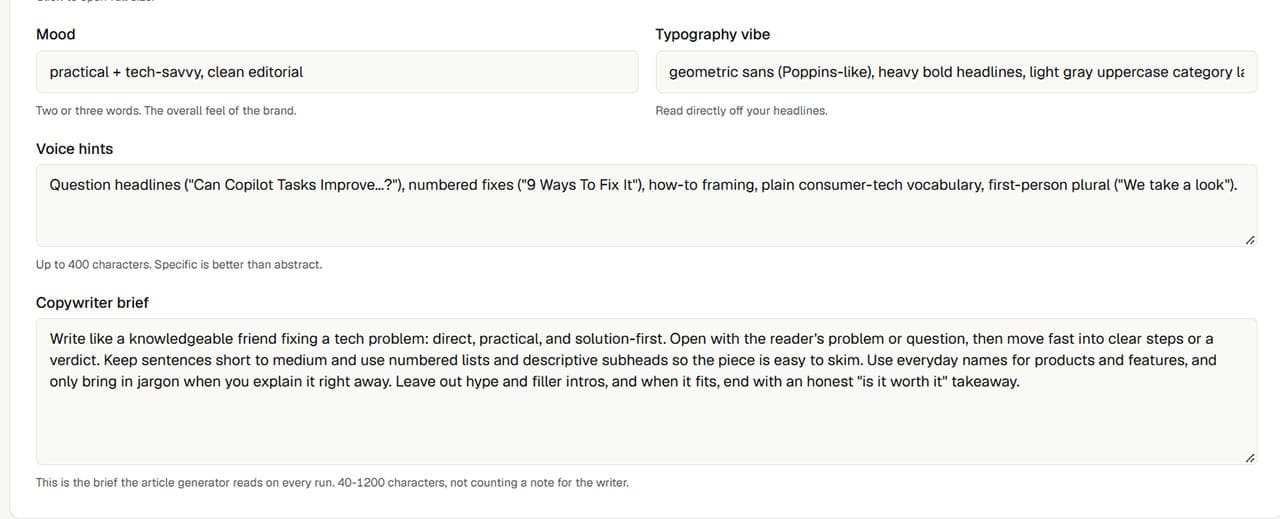
The AI does a solid job of distilling the “essence” of brand voice, but it doesn’t always abide by that when actually generating the articles.
The SEO Agent AI Review: What Works and What Doesn’t
On the surface, one of the tool’s stronger points is that once it finds a good keyword, it creates a decent article. The actual writing inside it can be a bit off and is worth taking a second look at, so you can’t really leave it to the AI to draft, create, and publish all by itself.
The bigger issue is that the only setup step you have is to orient your audience and competition, and neither of them is editable once you start using the plan. This means that if you make even a slight mistake during the setup or are trying to serve a relatively niche audience, the AI’s keywords may be only tangentially related to what you’re actually doing.
Furthermore, the AI’s limitations of one article per day and 30 per month mean that you can hit a wall if you want to broaden the website to cover multiple topics. The only solution is to get another website for $79 per month, about 80% of the standard subscription, or contact the company to discuss a higher-volume plan.
The SEO Agent Review: Pricing and Verdict
Speaking of the subscription, the only paid tier costs $99 per month. This is extremely high for an article generator that only outputs a short article per day that you still need to edit manually.
Overall, use the three-day “trial” for $1 to the best of your ability, tinkering by trying to modify or orient the keywords to be as original as possible. This will give you a true preview of the AI’s research capabilities rather than how much it can rewrite existing pieces.
Related Posts
 ZenCall AI Review: Can an AI Call Answering Agent Handle Your Phone?
 Testing Watermelon AI: How Simple Is Agent Creation?
 How to Set Up an AI Agent for Teams
 Azure AI Foundry vs. Copilot Studio: Which AI Agent Platform Do You Need?
 7 AI Apps That Help You Create SEO-Ready Content for Google
 How to Automate Your Blog’s SEO With Tely.AI and Convert More Leads
 Is Purple Leaf AI Worth It for Your AEO/GEO and SEO Game?
 How to Turn ICP Research Into SEO Content With Wordrific AI
 How to Spot Competitor Changes With Let Me Know When AI Tool

Disclaimer: Some pages on this site may include an affiliate link. This does not effect our editorial in any way.