
Claude continues to advance its Large Language Models (LLMs) and service offerings with the release of Claude 4. This next generation leap actually involves two different offerings: the fast and simple Claude Sonnet 4, and the slower, more complex Claude Opus 4.
What does this new version mean for you and your experience with Claude? Well, that’s the focus of this article on Claude 4 updates.
Claude 4 Updates – Ever Improving

Anthropic’s release of updates for both its LLMs aims to improve the chatbot’s capabilities and iron out its rougher aspects. Claude is already well known for offering more creativity and naturalistic responses than other chatbots.
If you’re looking to test out the new features of Claude, then besides the site itself, there are options for developers to integrate the models through API, or through GitHub’s very own Copilot chat. Keep in mind that your access will depend on your subscription level, with Opus 4 reserved for users on a paid plan.
Let’s look at both Sonnet and Opus to see what’s new.
Sonnet 4
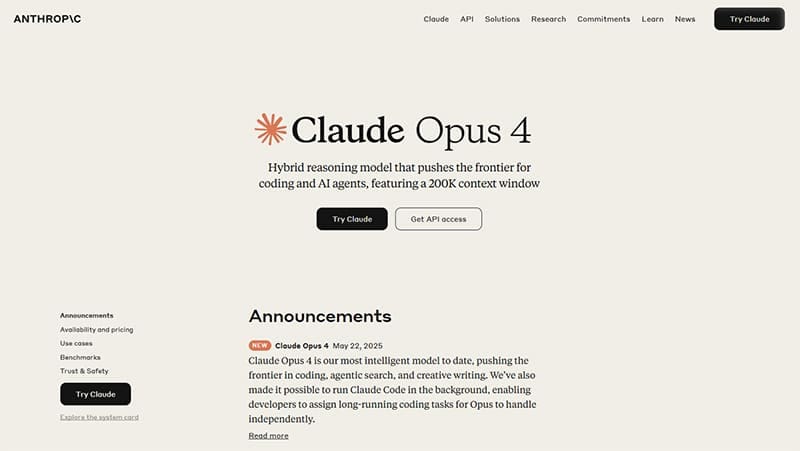
If you’re looking for speed and efficiency when using Claude, then Sonnet 4 is your go-to. Sonnet has come a long way since its earlier models, which were designed mostly towards summarizing and chat responses. Starting with 3.5, the LLM was able to accommodate larger inputs, while offering better response consistency and more in-depth responses.
A big problem with previous versions was hallucination and shortcuts taken to arrive at responses. Users often couldn’t see the chain of reasoning used to arrive at a conclusion.
Sonnet 4 is an improvement in many ways. Let’s look at some of the major ones:
- Better Optimization – Sonnet is now able to tackle more everyday tasks, such as a daily assistant, writing code, document analysis, and data extraction.
- Bigger Input and Output – Sonnet 4 supports a context window of 200K, allowing it to process bigger inputs and offer more detailed, even multi-part responses. This is thanks to its new 64K output window.
- Improved Speed – While Sonnet 4 may still struggle with data extraction and processing more complex input, the speed and navigation are an improvement over 3.7.
- Accessibility – Many chatbots don’t allow free users access to their most advanced LLMs, but Claude makes Sonnet 4 free to all.
Opus 4
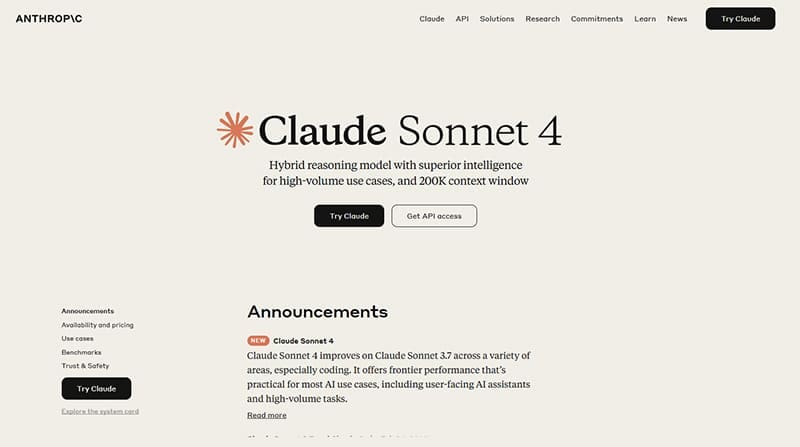
Opus is the newest LLM Claude 4 news and it places its focus on complex reasoning and more thorough responses. It’s where Claude gets to strut its stuff with naturalistic writing and long-term memory. Quick and easy might work for most workflows, but Opus knows sometimes users need more, and are willing to pay for it.
Here’s what Opus 4 has to offer:
- Coding – Opus’s ability to code is better than ever, making it one of the best in the industry. Full stack architectures, code refactoring, and the steps for breaking down processes are unrivaled. To top it off, you don’t need to input much.
- Memory – Not only is Opus 4’s memory improved, but it’s better able to track its own thoughts and refer back to previous memories with greater ease and clarity.
- Agent Workflows – Opus 4 has scored well on benchmark tests like the TAU and so is perfectly suited for building agents that can handle complex reasoning and multistep development workflows, from creation and implementation to refinement.
Related Posts
 ChatGPT vs. Gemini vs. Claude – How Do They Compare?
 DeepSeek vs. ChatGPT vs. Claude – Or None of Them?
 Best Minecraft Skin AI Generator
 How to Get the Most Out of ProBot on Discord
 Best AI Username Generator for Instagram
 Top Resume Parser AI Free Tools
 Best AI Tools for Video Editors That Deliver Amazing Results
 Top 3 Best AI Content Detectors That Are Accurate

Disclaimer: Some pages on this site may include an affiliate link. This does not effect our editorial in any way.